Start with verifiable facts
A product description should help shoppers understand what they will receive and whether it suits their intended use. Before asking an AI tool to draft it, gather the manufacturer’s or supplier’s information: materials, dimensions, included items, instructions for use and care. Check that the data applies to the specific model and variant.
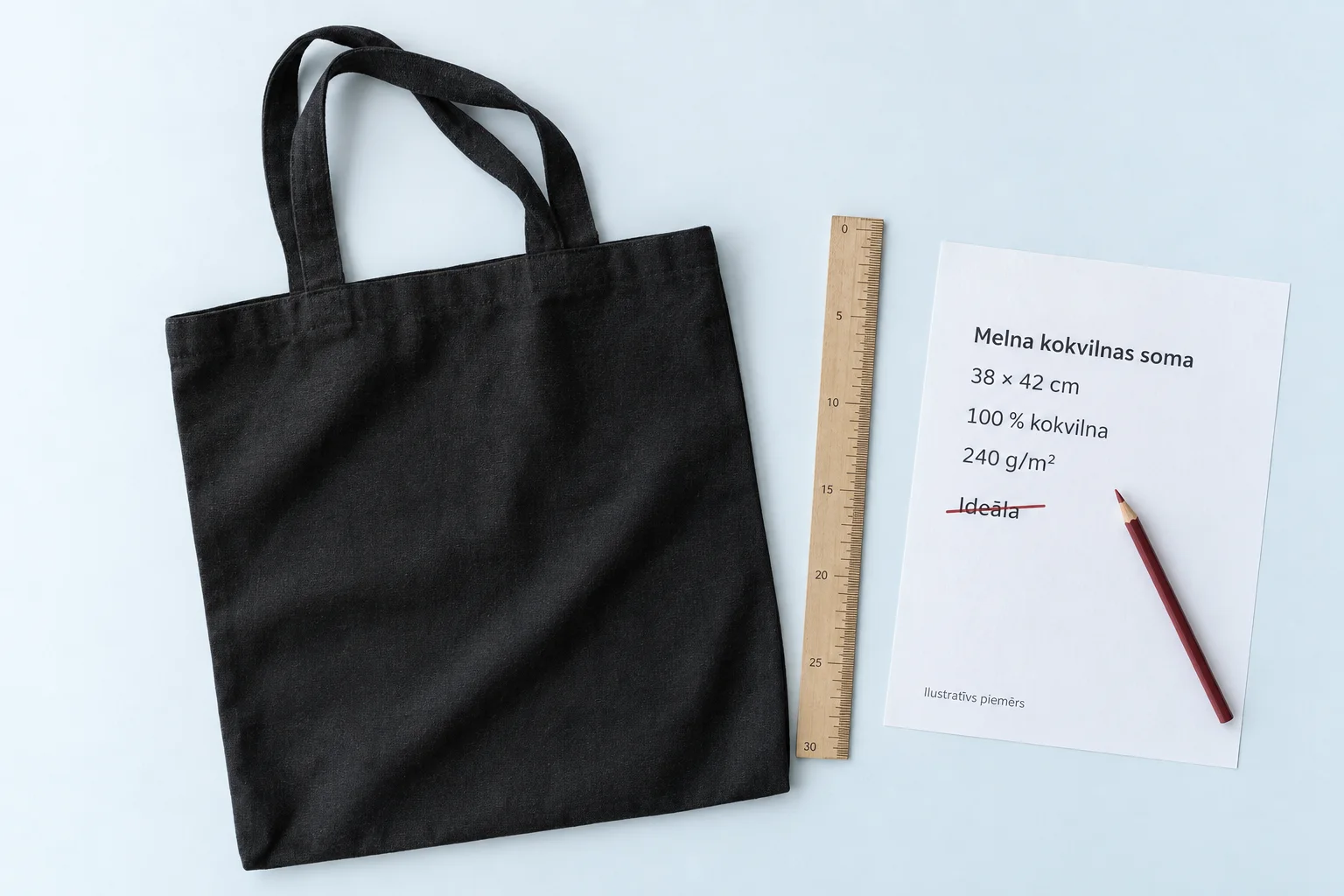
We will use a fictional fabric bag as an example. The product data and both descriptions were created for this article; they are not responses from a particular AI tool or results from a client project.
- Material: 100% cotton, fabric weight 240 g/m².
- Dimensions: width 38 cm, height 42 cm.
- Handle length: 70 cm.
- Colour: black.
- Fastening and pockets: none.
- Care: wash at 30 °C; do not tumble dry.
- Maximum load and country of origin: not specified.
These details are enough for a short description. They do not support claims that the bag is particularly durable, made in Latvia or suitable for carrying heavy shopping. If a feature matters to the purchase decision, ask the supplier for the missing information.
A prompt you can reuse
Tell the AI tool who the text is for, which facts to use and what to do when information is missing. Adapt this prompt for other products by adding their details at the end.
Example prompt
Draft a product description in English for an online store, using only the data below.
Write clearly and professionally. Start with the product name and a short paragraph about its features. Then list dimensions, materials, included items and care instructions separately, where provided. Avoid repeating the same fact unnecessarily.
Do not add assumptions about quality, durability, origin, certifications or environmental impact. Do not promise a delivery date. Avoid descriptions such as “perfect”, “premium quality” or “essential”. If information that matters to shoppers is missing, write questions for the supplier after the description. Keep those questions separate from the text intended for publication.
Product data: [insert verified information here].
The response still needs checking. Telling a tool not to invent facts does not ensure that the text will be free of errors.
How to edit the draft
Suppose the draft you are reviewing contains this passage:
“A durable, eco-friendly cotton bag for everyday shopping. Long handles make it comfortable to carry on your shoulder, while its spacious design makes it the perfect companion for a busy day.”
This is an illustrative draft with deliberately unsupported wording. The supplied data does not substantiate “durable” or “eco-friendly”. Handle length alone does not establish comfort either. “The perfect companion for a busy day” does not help the shopper choose and can be removed.
The description could be revised as follows:
Black cotton bag, 38 × 42 cm
A black fabric bag made from 100% cotton, with no fastening or pockets. The handles are 70 cm long.
- Width: 38 cm; height: 42 cm.
- Fabric weight: 240 g/m².
- Care: wash at 30 °C. Do not tumble dry.
This version gives shoppers specific measurements and care instructions. The absence of a fastening and pockets may also affect their choice, so that information has been retained. If the bag will be offered for carrying heavy shopping, its maximum load needs to be established first.
What to check before publishing
Compare the description with the original data and read it aloud. Check four things:
- Facts. Are all numbers, units, materials and care instructions correct? Does the description match the selected colour, size and model?
- Claims. Can every stated feature be substantiated? Remove promises that appeared only in the draft.
- Language. Is this how you would describe the product to a customer? Replace awkward wording with specific information. Instead of “offers a convenient storage solution”, write “has two inside pockets”, for example, if the product actually has them.
- Shoppers’ questions. Is it clear what is included and which limitations matter? Obtain missing information before publishing.
If you need descriptions for several similar products, refine one example first. Use it to guide the structure and tone of the others. Check each product’s data separately; a feature of one model must not be applied to the whole collection.
A description also helps shoppers find the product
Google recommends informative product descriptions using the words shoppers search with. In this example, “black cotton bag” clearly names what is for sale. There is no need to repeat the phrase in every sentence.
Google’s guidance on AI-generated content also emphasises accuracy, quality and relevance to readers. Revising a description does not, by itself, guarantee a higher search ranking or a recommendation in an AI answer.
For more on the information that helps a business be found through AI search, read “How can a Latvian business appear in ChatGPT answers?”.